
What Is a Remote Keyless System?
At its core, a remote keyless system (often called Remote Keyless Entry or RKE) is the technology that grants you access to your vehicle without ever inserting a physical metal key into the door lock. We have moved far beyond simple convenience; these systems are now the standard for vehicle security and access.
When we talk about a remote keyless entry system, we are referring to an electronic lock that controls access to a building or vehicle. For cars, the primary functions generally include:
- Locking and Unlocking: Securing the doors with a single click.
- Trunk Release: Popping the hatch or trunk remotely.
- Panic Button: Triggering the alarm in emergencies.
- Remote Start: Igniting the engine from a distance to warm up or cool down the cabin (common in the best remote start and keyless entry system configurations).
Key Components of an RKE System
To understand how this magic works, we need to look at the hardware involved. A standard remote keyless system relies on a synchronized communication loop between four main components:
- Transmitter (Key Fob): The handheld device you carry. It sends a specific radio signal when you press a button.
- Radio Receiver: Located inside the vehicle, this unit listens constantly for the unique signal from your specific fob.
- Antennas: These capture the signal and direct it to the receiver to ensure range and reliability.
- Control Module: The “brain” of the operation. Once the signal is verified, this module sends the electrical impulse to the door lock actuators or ignition system.
Understanding Radio Frequencies
One of the most critical aspects of these systems—and a common point of confusion when looking for a car key fob replacement—is the operating frequency.
- 315 MHz: This is the standard frequency used for remote keyless systems in North America (United States and Canada) and Japan.
- 433 MHz (or 433.92 MHz): This is the standard for Europe and parts of Asia.
Why does this matter to you? You cannot mix and match. If you buy an aftermarket remote keyless entry system or a replacement fob designed for the European market, it will not communicate with a US-spec vehicle. Always verify that your frequency matches the region where your car was manufactured for sale.
How Remote Keyless Systems Work
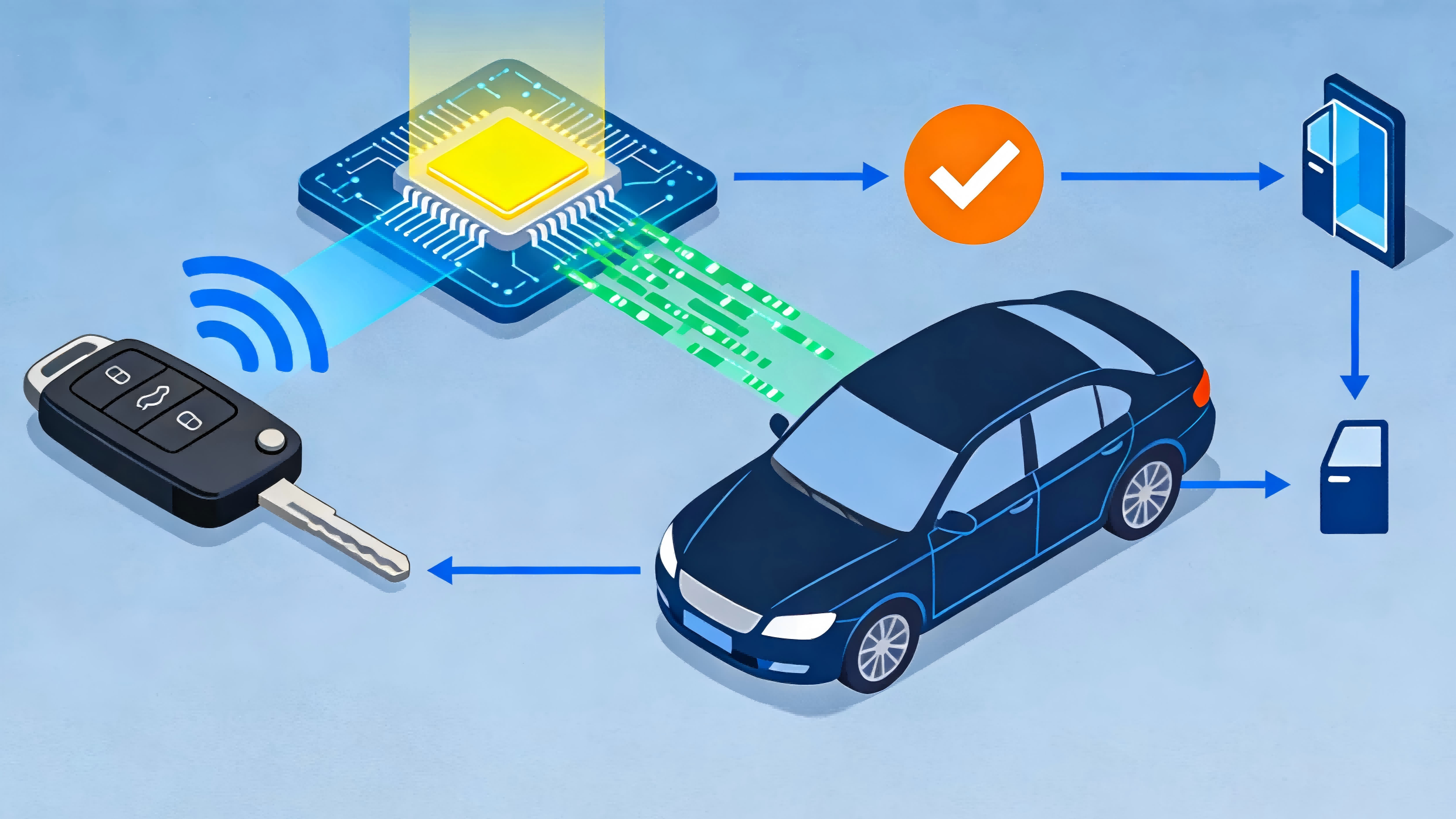
When you click the button on your fob, it feels instant, but there is a complex digital conversation happening between your hand and your car. A remote keyless system doesn’t just broadcast a simple “open” command; if it did, anyone with a radio scanner could steal your car in seconds.
The Signal Transmission Process
At its core, the system relies on short-range radio transmissions. Here is what happens in the millisecond after you press the button:
- Wake Up: Pressing the button wakes up the CPU inside your keyless entry transmitter (the fob).
- Data Stream: The fob sends a data stream containing a command (lock/unlock) and security data to the vehicle via Radio Frequency (RF).
- Verification: The receiver inside the car captures this signal. It decodes the data and sends it to the control module.
- Action: If the security codes match what the car’s computer expects, the Body Control Module (BCM) triggers the door locks, disarms the alarm, or pops the trunk.
Understanding how these signals travel is useful, especially if you drop your keys. If you know the range of your transmitter, you can use that knowledge to narrow down the search area when learning how to find a lost key fob in your car fast.
Security Protocols: Rolling Codes vs. Fixed Codes
The biggest evolution in remote keyless entry systems is how they handle security.
- Fixed Codes (Old School): Early systems used a static code. If your code was “12345,” it was “12345” every time. Thieves used “code grabbers” to record this signal and replay it later to unlock your car.
- Rolling Code Technology (The Standard): Modern systems use a pseudo-random number generator. Every time you press the button, the code changes. The car and the remote share a secret algorithm that allows them to remain in sync. Even if a thief intercepts the code you just used, it is useless because the car has already “rolled” to the next valid code.
Integration with Alarms and Immobilizers
A remote keyless system is rarely a standalone unit anymore; it is the gatekeeper for your vehicle’s entire security network.
When the system validates your signal, it does three things simultaneously:
- Central Locking: Actuates the motors in the doors to unlock.
- Alarm Disarm: Tells the security system to stand down so opening the door doesn’t trigger the siren.
- Immobilizer Handshake: In many remote start and security systems with keyless entry, unlocking the car prepares the engine immobilizer to accept the ignition signal, ensuring the car can actually drive away.
Remote Keyless Entry vs. Passive Keyless Entry
There is often confusion between a standard remote keyless system and the newer “smart” keys. While both get you into your car without inserting a metal blade into a lock, how they communicate with your vehicle is completely different. Understanding this distinction is huge when you are looking for a car key fob replacement or trying to diagnose a battery drain.
Active RKE vs. Passive PKE (Smart Key Systems)
The main difference lies in whether you have to do the work or if the car does it for you.
- Active RKE (Remote Keyless Entry): This is the classic style. You must physically press a button on your keyless entry transmitter to lock or unlock the doors. The fob sends a specific radio frequency signal to the receiver in the car. It’s intentional and user-controlled.
- Passive PKE (Passive Keyless Entry): This is often marketed as a smart key system or vehicle keyless go. You keep the fob in your pocket or purse. As you approach the vehicle, antennas in the car’s bodywork detect the fob’s unique ID. When you grab the door handle, the system authenticates the key instantly and unlocks.
Many luxury vehicles, such as those requiring a 2004-2016 BMW CAS system remote, utilize advanced passive technology that integrates with the engine immobilizer for push-button starts.
Pros, Cons, and Convenience Factors
Here is a quick breakdown to help you compare the two technologies:
| Feature | Active RKE (Button Press) | Passive PKE (Proximity) |
|---|---|---|
| Convenience | Moderate. Requires hand interaction. | High. Hands-free entry and start. |
| Battery Life | Long (3-5 years). Transmits only when pressed. | Shorter (1-2 years). Constantly “listening” for the car. |
| Security Risk | Lower risk of accidental unlocking. | Higher risk of relay attacks (signal boosting). |
| Cost | More affordable to replace. | Expensive due to complex chips and programming. |
Emerging Tech: UWB Keyless Technology
The biggest downside to passive systems has been security. Thieves use “relay attacks” to boost the signal from a key fob sitting inside your house to trick the car in the driveway into opening.
This is where UWB keyless technology (Ultra-Wideband) changes the game. Unlike older radio signals, UWB measures the actual “Time of Flight” of the signal. It calculates exactly how long it takes for the signal to travel from the fob to the car.
- Relay Attack Prevention: If the signal takes too long (even by nanoseconds) because it’s being relayed from a distance, the car knows the key isn’t actually nearby and refuses to unlock.
- Precision: UWB is accurate within centimeters, making it the future standard for secure remote keyless systems.
We are seeing a rapid shift toward these safer systems, so if you are upgrading or buying new, checking for UWB capability is a smart move for vehicle security.
Common Issues with Remote Keyless Systems
Even the most reliable remote keyless entry system can run into snags. I’ve handled enough customer calls to know that 90% of the time, the issue is simple, but it can feel catastrophic when you’re standing in the rain locked out of your car. Here is how to diagnose the problem and get back on the road.
Diagnosing Dead Key Fob Battery Symptoms
Before you assume the entire system is fried, check the power source. A dying battery doesn’t usually quit all at once; it gives you warning signs. If you have to press the button multiple times to get a response, or if the range has dropped significantly (you have to be right next to the driver’s door), it’s time for a key fob battery replacement. Also, check the LED light on your keyless entry remote—if it’s dim or doesn’t flash at all, that is a dead giveaway.
Troubleshooting Signal Interference and Range Reduction
Sometimes the battery is fresh, but the car still won’t unlock. This often points to signal interference. Large radio towers, power lines, or even other powerful electronic devices can jam the signal between your keyless entry transmitter and the vehicle.
If your range is consistently poor in different locations, verify that your remote is operating on the correct frequency. You can check our guide on how to identify if your car key is 315MHz or 433MHz to ensure your device matches your vehicle’s receiver requirements. Mismatched frequencies are a common reason for poor performance after buying an aftermarket replacement.
Fixing Sync Issues After Battery Replacement
A common panic moment happens right after changing the battery: the remote still doesn’t work. This doesn’t mean the remote keyless system is broken; it likely just lost its synchronization with the car’s computer.
Most vehicles require a simple resync procedure after a power loss.
- Ford/GM: Often involves holding “Lock” and “Unlock” simultaneously near the vehicle.
- Honda/Toyota: May require a specific sequence of turning the ignition key and pressing buttons.
Always consult your owner’s manual before paying a locksmith to reprogram a remote that just needs a handshake with the car.
Security Vulnerabilities: Relay Attacks and Code Grabbing
Modern convenience comes with modern risks. Thieves are using sophisticated tech for “relay attacks,” where they amplify the signal from the smart key system inside your house to unlock the car in your driveway. This is a major issue for vehicles with passive keyless entry.
To boost relay attack prevention, store your fobs in a metal tin or a specialized Faraday bag (signal blocking pouch) when you are at home. Be aware of “code grabbing” devices in public parking lots—if your remote doesn’t lock the car on the first try, check the door manually to ensure a jammer isn’t blocking your lock signal.
How to Identify and Match Your Remote Keyless System
Finding the correct car key fob replacement for your vehicle isn’t just about picking a remote that looks like your old one. Internal electronics vary significantly even within the same car model year. I always advise customers to verify technical specifications before buying to ensure the remote keyless system actually syncs with the car’s computer.
Locating the FCC ID on Your Existing Remote
The most reliable way to guarantee compatibility is by matching the FCC ID. This is a unique alphanumeric code assigned by the Federal Communications Commission.
- Check the Back: Flip your remote over. On many units, the code is embossed on the back plastic.
- Open the Case: If the back is worn smooth, pop the case open (like you are changing the battery). The FCC ID is often printed on the circuit board or the inside of the shell.
- Consult the Owner’s Manual: If you lost the key entirely, your manual often lists the required keyless entry transmitter ID.
Matching this ID ensures that the remote keyless entry system frequency (usually 315 MHz in the US) and the security protocols align perfectly. For example, a specialized Jaguar and Land Rover 5-button remote requires you to match the exact Part Number (like CH22-15K601-AB) alongside the FCC ID to function correctly.
Using Year/Make/Model and Verifying Chips
While using a Year/Make/Model lookup tool is a great starting point, it isn’t foolproof. Manufacturers often switch remote keyless systems halfway through a production year.
Here is what you need to verify for a successful match:
- Frequency: US vehicles typically use 315 MHz, while imports might use 433 MHz. They are not interchangeable.
- Chip Type: The transponder chip inside the key (for the immobilizer) must match. A “G” chip will not work if your car requires an “H” chip, even if the remote looks identical.
- Button Configuration: Ensure the button count matches. If your original didn’t have a remote start button, a new keyless remote with that button won’t magically add the feature to your car.
Taking two minutes to verify these details saves you the headache of returning an incompatible aftermarket keyless remote. If you are unsure about the return process for unmatched parts, it is always smart to review our secure shopping policies beforehand to understand how we handle exchanges.
Replacing or Upgrading Your Remote Keyless System
When your remote keyless system fails, or you simply need a spare, the first instinct is often to head straight to the dealership. However, that is rarely the most wallet-friendly option. Whether you are dealing with a lost fob or upgrading an older vehicle to a modern keyless entry remote, knowing your buying options can save you hundreds of dollars. We believe in making car access affordable and straightforward, without sacrificing security or quality.
Dealership vs. Factory-Direct Pricing
The price gap between a dealer and a factory-direct provider is massive. Dealerships often mark up the hardware significantly and charge high hourly labor rates for key fob programming. By purchasing directly from specialized providers, you cut out the middleman.
| Feature | Dealership | Factory-Direct / Online |
|---|---|---|
| Hardware Cost | High (MSRP + Markup) | Low (Wholesale/Direct) |
| Programming | Expensive Labor Fees | DIY or Local Locksmith |
| Convenience | Appointment Required | Shipped to Door |
| Variety | Stock Limited to Brand | Wide Make/Model Selection |
OEM vs. High-Quality Aftermarket Options
You generally have two choices for car key fob replacement: Original Equipment Manufacturer (OEM) or aftermarket. OEM remotes are the exact same parts used by the manufacturer. High-quality aftermarket keyless remote options use the same technology and frequencies but come at a fraction of the cost.
For example, if you drive a Ford, you might be looking for a specific 2026 Ford Expedition keyless entry remote that matches your SUV’s FCC ID perfectly. Alternatively, Toyota owners often seek a reliable Toyota Camry Hybrid remote that pairs seamlessly with their push-to-start system. We ensure that whether you choose OEM or aftermarket, the chip type and frequency are verified for reliable performance.
Benefits of Going Factory-Direct
Choosing a specialized provider for your remote keyless entry system components offers more than just savings. It guarantees you are getting parts that actually work with your vehicle.
- Warranty Protection: Unlike used fobs from auction sites, reputable direct providers offer warranties on electronics.
- Material Quality: We use durable casings and buttons designed to withstand daily wear and tear, similar to factory standards.
- Guaranteed Compatibility: By matching the Year/Make/Model and FCC ID, we ensure the remote will sync with your car’s receiver.
Would you like me to create a troubleshooting checklist for programming your new remote yourself?
DIY Programming and Maintenance Tips
Managing your own remote keyless entry system maintenance is one of the easiest ways to save cash. Dealerships often charge over a hundred dollars just to press a few buttons or swap a battery, but with a little patience, I’ve found that most vehicle owners can handle the basics right in their driveway. Whether you are dealing with a standard keyless entry transmitter or a slightly more complex aftermarket remote keyless entry system, here is how you can keep things running smoothly.
Step-by-Step Self-Programming for Popular Brands
Before you pay for professional programming, check if your vehicle allows for “on-board” programming. This means you can sync the keyless entry remote to the car using a specific sequence of actions—like opening doors or turning the ignition key—without needing special computers.
Here are the general procedures for three of the most common makes in the US. Note: These steps work for many standard keyed ignitions but may vary by year and model.
- Ford: Insert the key into the ignition. Cycle the key from “Off” to “Run” (without starting the engine) 8 times rapidly within 10 seconds. On the 8th turn, leave it in “Run.” The door locks should cycle (lock and unlock) to confirm pairing mode. Press any button on your new remote to sync it.
- Honda: Insert the key, turn to “On,” press the “Lock” button on the remote, and turn back to “Off.” Repeat this cycle 3 to 4 times until the door locks cycle. If you are upgrading or replacing a unit, such as a 2017-2020 Honda Civic key fob, verify if your specific trim level supports this manual method, as newer models often require OBD diagnostics.
- Toyota: Start with the driver’s door open and unlocked. Insert and remove the key from the ignition twice (do not turn it). Close and open the driver’s door twice. Insert the key again and remove it. Close and open the door twice more, then insert the key and close the door. Turn the ignition “On” then “Off” once to enter programming mode.
Guide to Replacing Common Batteries (CR2032, CR2026)
A dying battery is the number one reason for remote keyless system failure. If you have to stand right next to the window to unlock the car, it is time for a key fob battery replacement.
Most remotes use lithium coin batteries, specifically the CR2032 or CR2026. Here is the quick fix:
- Identify the Slot: Look for a small notch on the side of the fob casing.
- Open Carefully: Use a small flathead screwdriver or a coin to gently twist and pop the case open. Do not force it, or you might crack the plastic shell.
- Swap the Cell: Note which side is positive (+) (usually facing up). Remove the old battery and slide the new one in.
- Test It: Snap the case back together and test the lock/unlock buttons immediately.
When to Stop DIY and Call a Professional Locksmith
While I love a good DIY project, there are limits. Modern smart key systems and vehicle keyless go setups use encrypted rolling code technology that cannot be programmed by simply turning a key in the ignition.
You should stop and call a professional locksmith if:
- You have a Push-to-Start vehicle: These almost always require a computer to interface with the car’s immobilizer.
- The car is European: Brands like BMW, Audi, and VW usually require proprietary software to add a remote keyless entry system.
- Syncing Fails Repeatedly: If you have tried the manual steps three times with no luck, there may be a receiver issue or a defect in the keyless entry transmitter itself.
Attempting to force-program a complex remote start and security system with keyless entry can sometimes trigger the vehicle’s anti-theft lockdown, turning a cheap fix into an expensive tow. Know your limits and bring in a pro when the tech gets too advanced.
Future of Remote Keyless Technology
The automotive world is moving fast, and the days of carrying a bulky keychain might be numbered. We are seeing a massive shift toward “Phone-as-a-Key” (PaaK) technology, where your smartphone completely replaces the physical transmitter. Major tech giants and automakers are collaborating on Digital Key standards, allowing you to unlock and start your engine just by having your phone in your pocket.
The Shift to Smartphone-as-Key and Digital Keys
This isn’t just about an app that locks your doors; it is about deep system integration. Using UWB keyless technology (Ultra-Wideband), your car can pinpoint your phone’s location within centimeters. This prevents the security holes found in older Bluetooth or RF systems.
- Convenience: You can “share” a digital key with a friend via text message for temporary access.
- Customization: The vehicle adjusts seats, mirrors, and radio presets based on which digital profile enters the car.
Biometric Integration and Smarter Security
Beyond phones, the industry is looking at biometric integration to create a truly unstealable vehicle. We are talking about fingerprint sensors on door handles and facial recognition cameras on the dashboard. This adds a layer of multi-factor authentication—even if someone steals your signal, they can’t replicate your fingerprint.
While this high-tech future is exciting, physical hardware is still the reality for most of us today. Whether you need a replacement for a modern smart key system or a standard 2010-2012 Ford Taurus key fob, physical remotes will coexist with digital tech for years to come.
Market Trends: Safer and Smarter Entry
The goal is to eliminate the “Relay Attack.” New Vehicle keyless go systems are adopting “time-of-flight” measurements to ensure the key is physically present, not just amplified from a distance. As we move forward, expect remote keyless entry systems to become less about pressing buttons and more about seamless, invisible security.
Related Sources
https://www.analog.com/en/resources/app-notes/remote-keyless-entry-systems-overview.html
https://en.wikipedia.org/wiki/Rolling_code
https://www.bmw.com/en/innovation/bmw-digital-key-plus-ultra-wideband.html
https://www.sectigo.com/blog/why-automotive-key-fob-encryption-hacks-are-making-headlines
https://www.autozone.com/diy/electrical/how-to-program-a-keyless-entry-remote
https://www.wikihow.com/Replace-the-Battery-in-a-Key-Fob
https://www.kbb.com/car-advice/vehicles-using-digital-keys
https://www.consumeraffairs.com/automotive/is-a-key-fob-covered-under-warranty.html
https://en.wikipedia.org/wiki/Rolling_code
https://vicone.com/blog/from-key-fob-to-uwb-how-hackers-hijack-vehicle-systems

thank you, please email us:ke*********@***il.com